
A Billiards Legends Journey and his Visit to Huddersfield
Clark McConachy, affectionately known as “Mac,” was a name synonymous with cue sports for over half a century. A New Zealander born on April 15th, 1895, McConachy’s career was exemplified by remarkable skill, dedication, and an enduring passion for billiards and snooker. His journey from his home town of Glenorchy, Otago to the pinnacle of the cue sports world makes for an inspiring story which includes a notable visit to Huddersfield, the home of Cues n Views.
A staunch advocate for physical fitness, McConachy attributed his prolonged success to his rigorous routines. He was known to run up to four miles daily, abstained from smoking and alcohol, and even performed handstands around the billiard table as a warm-up.
Beyond his playing career, McConachy was deeply involved in promoting billiards and snooker. He often donated his exhibition match fees to hospital charities. In recognition of his contributions, he was appointed a Member of the Order of the British Empire (MBE) in 1964 and was posthumously inducted into the New Zealand Sports Hall of Fame in 1990.
Billiards dominance
McConachy’s introduction to billiards began in his teenage years, working in his father’s billiard saloon in Timaru. Under the guidance of Alf Southerwood, he honed his skills, and by 17, he was making breaks of 1,000.
In 1915, he clinched the New Zealand professional billiards championship, a title he impressively held for an incredible 66 years until his passing in 1980.
McConachys prowess soon earned him international recognition. He became part of the esteemed “Big Four” of billiards, alongside Australian Walter Lindrum and Englishmen Joe Davis and Tom Newman. This quartet dominated the sport from the 1910s to the 1930s, showcasing unparalleled skill that, some say, led to a decline in spectator interest due to their overwhelming dominance.
His international career saw him consistently challenge the world’s best. He was a formidable opponent in the Professional Billiards Championship, finishing runner-up to the legendary Joe Davis in 1932.
McConachy’s persistence culminated in his winning of the World Professional Billiards Championship in 1951, defeating British champion John Barrie. He held this title until 1968, when he narrowly lost to Welshman Rex Williams, despite battling Parkinson’s disease at the age of 73.
Throughout his career, McConachy achieved numerous remarkable feats. He was the first player to make two breaks of over 1,000 in consecutive matches. His personal best break was an astounding 1,943 against Joe Davis in 1932. Additionally, he set a record of 466 consecutive cannons in a match held in Manchester.
Snooker mark
Beyond billiards, McConachy also made his mark in snooker. He was a two-time World Snooker Championship finalist, first in 1932 (against Joe Davis) and then again in 1952. He also compiled over 300 century breaks in his career.
Notably, McConachy scored one of the early snooker maximum breaks in a practice frame against Pat Kitchen. The break took place on Tuesday 19 February 1952, on a table reserved for professionals at the Beaufort Club in London.
Later an official of the Billiards Association and Control Council examined the table and found it slightly over the standard size and so the break was not accepted as official. At the time Joe Davis held the record for the highest official break of 146.
Huddersfield visit: A Glimpse into a Champion’s Tour
During his illustrious career, McConachy frequently traveled to England, the heartland of cue sports at the time, to compete against the best. While specific details of every exhibition or match he played are scarce, records indicate his involvement in a personal contract with Camkin for the 1930-31 season, where he played numerous matches across two weeks, involving twenty-four sessions of billiards and a session of snooker.
Clark McConachy was in Huddersfield for three days in March of 1947 to play the leading local players at Greenside Working Mens Club. McConachy made numerous century breaks along with one of 200, one of 313 and his best of 398 and also during those exhibition matches he made what was thought to be the first century break, 108 at snooker in Huddersfield against Clifford Percival.
While specific detailed reports of his Huddersfield visit are not readily available in widely published accounts, a player of McConachys stature attracted considerable local attention.
Such visits were common for professional players of the era, who often undertook exhibition tours and matches to engage with fans and promote the sport. For the local billiards and snooker enthusiasts in Huddersfield, witnessing a master of McConachys calibre was a memorable event, an opportunity to see first hand the precision and artistry that defined McConachys game.
Whether in New Zealand, Huddersfield, or any corner of the globe, from his incredible dominance in New Zealand to his world championships and record-breaking breaks. Clark McConachys legacy in the worlds of billiards and snooker is undeniable.
Visits by the top professionals like McConachy to towns like Huddersfield, with its rich sporting culture, were undoubtably crucial in bringing the magic of professional cue sports directly to communities and inspiring future generations of players.
John A Smith
Cues n Views
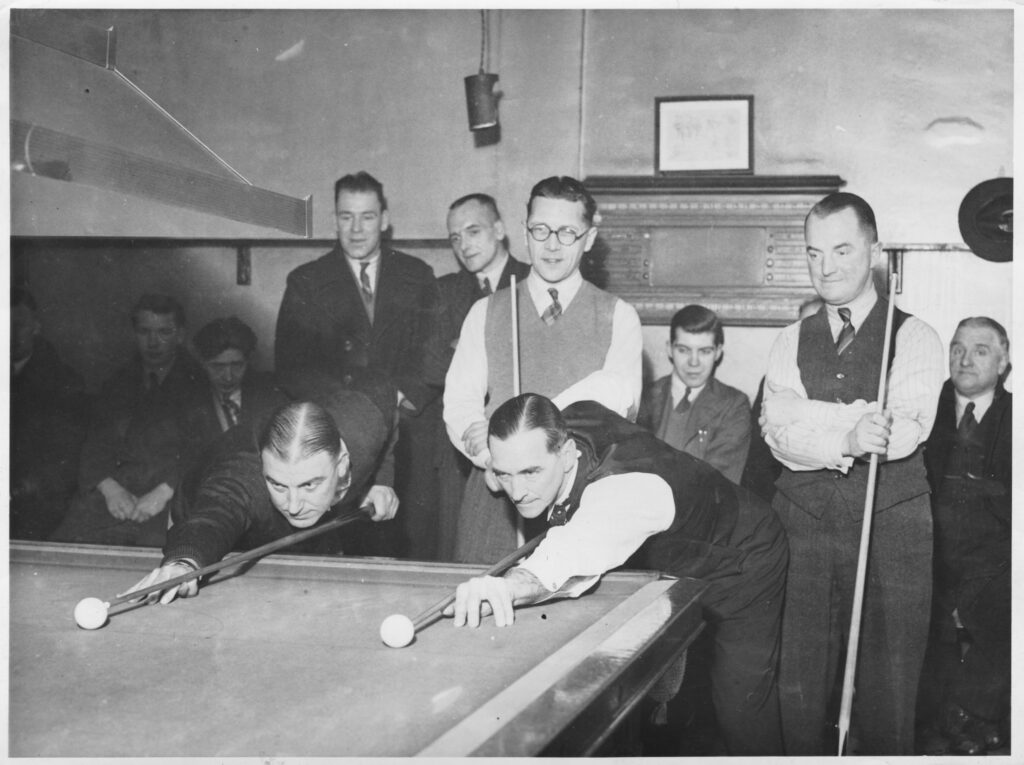
Cueing on the left is Victor Muff and on the right, Clark McConachy. Along with Jack Mellor standing, is Selwyn Bradley and a few other players who were to meet Clark: namely Gladney Hoyle, Clifford Percival and Ronnie Kershaw.
Acknowledgements:
Photo Courtessy of Jeff Mellor, Creator of the Jack Mellor web-site, a great resource of historical information.
Related cue images


