
A History of Billiard Tables, Cues and more
In the worlds of billiards and snooker few names resonate as deeply as Thomas Padmore & Sons. From humble beginnings in Birmingham to becoming a cornerstone of the sport’s equipment manufacturing, their story is one of innovation, resilience, and a commitment to the game.
Founding and Early Growth (1830s – Mid-19th Century)
The journey began in 1830 when Thomas Padmore moved from London to Birmingham. He established a business in Little Charles Street, initially focusing on wood and ivory turning and cabinet making. His early products included chessmen, paper knives, shaving brushes, and other fancy goods made from ivory or bone, with billiard balls being the closest connection to the game at this stage.
As the popularity of billiards grew, Padmore soon turned his skills to manufacturing billiard tables and associated equipment. In 1858, his two eldest sons, Thomas John Padmore and Edwin Padmore, joined the firm, and the company began trading as ‘Padmore & Sons’.
Expansion and Innovation (Late 19th – Early 20th Century)
A significant step in the company’s growth occurred in 1871 when the Little Charles Street building was demolished for road widening. This prompted a move to larger premises at 118 Edmund Street in Birmingham, an address that would become synonymous with billiards for the next 69 years. By 1875, references to their manufacturing and supply of billiard tables began to appear, though ivory turning remained part of their activities.
The business continued to thrive under the third generation, cousins Frank and Douglas Padmore, who significantly increased production. Their growth was undoubtedly aided by the 1885 agreement by the Control Club, which set rules and standards for billiard equipment. Padmore & Sons’ dedication to quality was recognized at the 1886 British Association Exhibition, where their billiard tables and accessories earned them two gold medals, later proudly displayed on their table plates. By 1895, billiard table manufacturing had become their primary focus.

The company also started serving as “Contractors for H M Government” from 1903, an inscription that subsequently appeared on their table plates.
Innovations in billiard tables included the introduction of the “Premier Low Fast Frost Proof Billiard Cushion” in 1905, which, after being used in a significant 1909 championship match, became known as the “Premier Championship” cushion. Padmore & Sons also supplied the billiard trade with various metal accessories, from gas lighting units to brass rest heads, cue clips, and ferrules.
Wartime Resilience and Post-War Recovery (Early to Mid-20th Century)
Like many industries, Thomas Padmore & Sons’ normal operations were impacted by the World Wars. During World War I, the factory primarily shifted to war work. After the war, billiard equipment manufacturing once again took precedence, though billiard balls were still largely hand-turned from ivory.
The company’s reputation extended globally, with their tables being used for national championships in Norway and the 1933 World Championship featuring Walter Lindrum, Joe Davis, Tom Newman, and Clark McConachy. Notably, Walter Lindrum, widely regarded as a great exponent of English Billiards, endorsed Padmore Billiard Tables and equipment. The firm also developed a distinctive new logo in 1928, featuring an extended ‘P’.

World War II also brought significant challenges, as the Edmund Street premises, including offices, factory, warehouse, and showrooms, were completely destroyed in the 1940 blitz, resulting in the loss of all historical company records. Despite this setback, Edgar Padmore, a fourth-generation family member, managed to secure temporary accommodations and government munitions contracts, maintaining operations through licensed billiard repair work for military and civil defense services.
Following the war, new permanent premises were established at 3 Coleshill Street, Birmingham, along with a modern factory. The company focused on manufacturing accessories and restoring tables, while building up timber stocks for future table production. In 1951, the firm became a limited company, Thomas Padmore & Sons Ltd, and even managed three billiard halls.
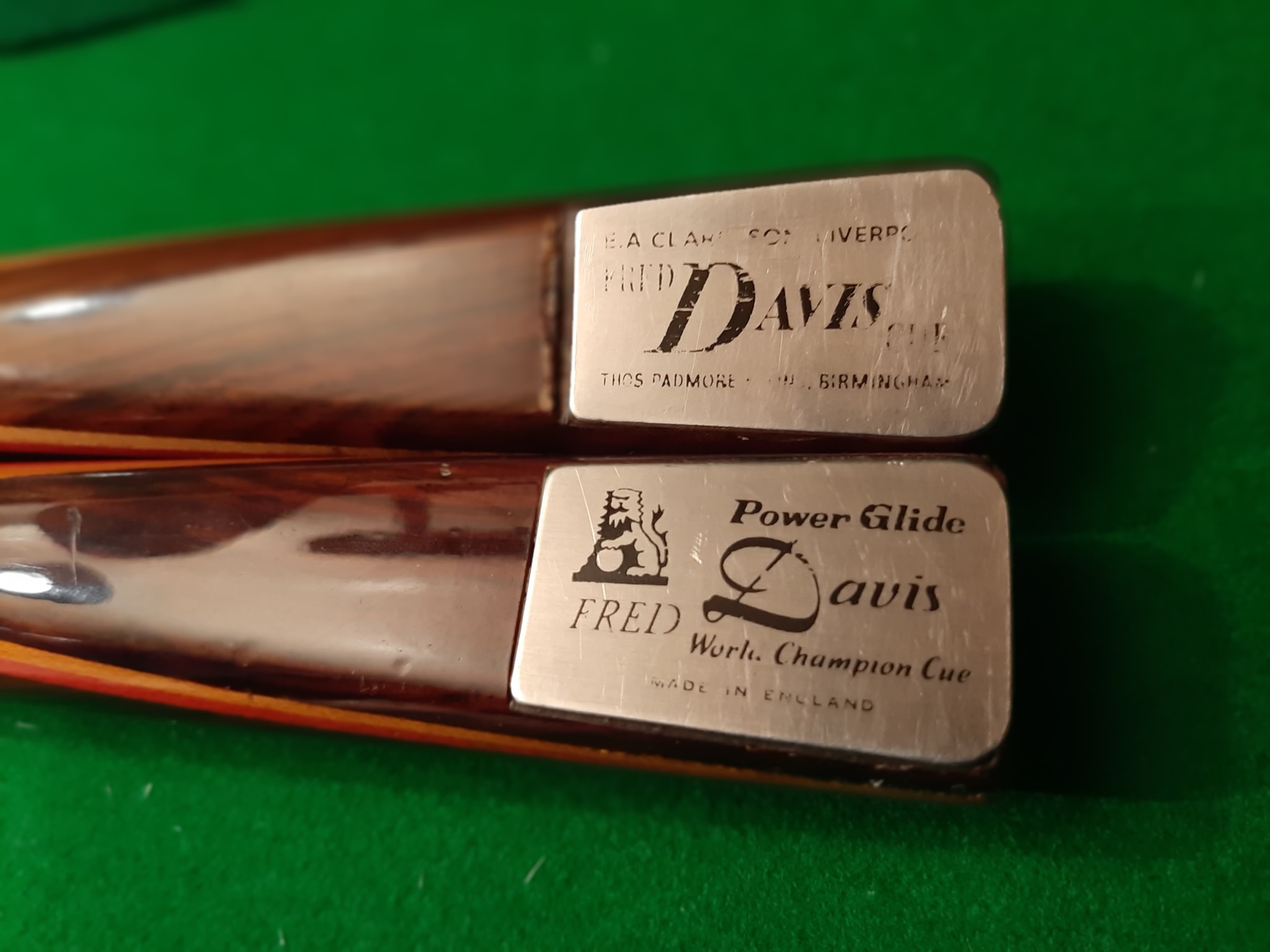
Following the introduction of the new logo in 1928 Padmore supplied a range of cues mostly made by Peradon, the ‘Premier’ Match cue, the Tournament cue, in 1953 the Coronation cue, in 1955 the Anniversary cue and the Premier Club cue.
Mergers, Modernization, and Cues (Late 20th Century – Present)
The late 1950s and 1960s saw further changes due to compulsory purchases of their premises for urban development, leading to moves to Cheshire Street and then to 180 Lozells Road in 1969. A pivotal moment arrived in 1966 when Thomas Padmore & Sons joined with E A Clare & Son of Liverpool and Thurston & Co. of London, forming the Clare-Padmore-Thurston Group. Neville Padmore became the managing director of this new group.
Under this new group, their billiard tables continued to be featured in major events, including the World Professional Snooker Championships, national championships, and the BBC’s “Pot Black” programmes from its inception in 1969.

The collaboration within the Clare-Padmore-Thurston Group brought forth several notable cues, for example: a Joe Davis Champion Cue, the ‘Standfast’ Cue is identified as a trade name for Clare-Padmore-Thurston, the ‘Consul’ plate on some cues indicates a Clare-Padmore-Thurston model and a ‘Clubman’ cue. Many of these cues were manufactured by Peradon & Co.
In 1988, the individual identity of Padmore was eventually absorbed, as all companies within the Clare Group began trading solely under the ‘Thurston’ banner. Despite this, the Padmore family association continued, with Gordon Padmore, the great, great, great grandson of the founder, joining the business in 1974 and running the Birmingham office.
Today, while the physical retail outlets in Liverpool and the Birmingham office have closed as of 2020-2021, sales of snooker and pool tables and accessories, including cues, are primarily conducted via the Thurston e-shop. The legacy of Thomas Padmore & Sons, a family business established over 190 years ago, continues through the Thurston brand, preserving its significant place in the history of billiard equipment.
John A Smith
Cues n Views