

More:
-
Frederick Mortlock
-
William Sykes
-
Norval & Sons
-
Burnley Billiard Works Enquiry
-
Kent & Co
-
What is a snooker?
-
H J Davis
-
Sidney Smith Billiards Champion
-
Maurice Tate Brighton
-
Billiards Expounded and the Valet
-
The Shadowless Billiards Shade
-
Old Book
-
Billiard Match Tickets 1905
-
Frank Lupton Cue Plates
-
Kingsley Kennerley cues
-
Four Little Snookers
-
A W Chick
-
Albert W Gamage and Cue
The School of Recreation,
(or the Gentleman’s Tutor to the most Ingenious Exercises)
by Robert Howlett
Perhaps old billiard books are not to everyone’s taste, but there was no shortage of interest at Forum Auctions, London, on 9th June 2020, when one of the earliest publications referencing billiards appeared. This was a rare first edition of ‘The School of Recreation, (or the Gentleman’s Tutor to the most Ingenious Exercises)’ by Robert Howlett, which was published in 1684.
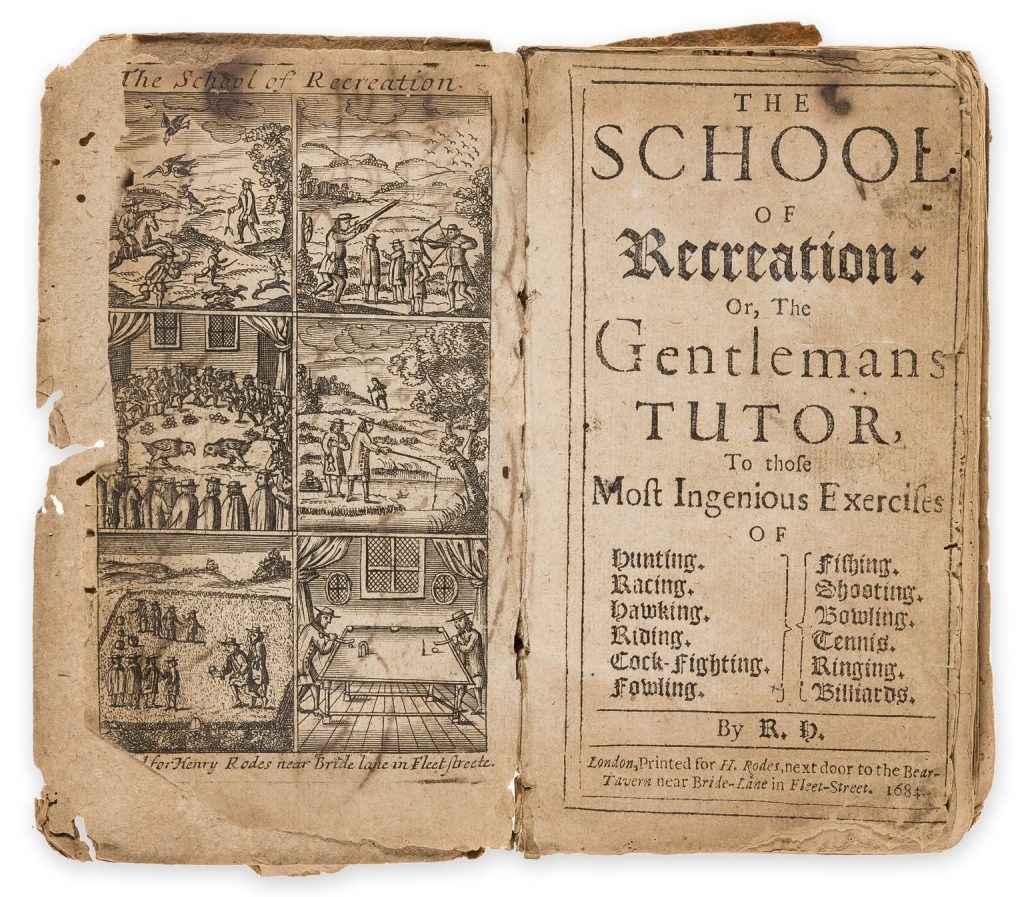
Written in the reign of King Charles II, the book, in addition to billiards, includes useful advice on such popular pastimes as hunting, horse racing, hawking, cock-fighting, fowling, fishing, shooting, bowling, tennis, and bell-ringing.
The billiards section seems to be directly modelled on Charles Cottons ‘Complete Gamester’ published a decade earlier in 1674. The text had been sufficiently rephrased to avoid copyright issues, but it was clearly taken from Cottons narrative albeit with some new additions. Perhaps not surprisingly,
Howlett endorses Cottons opinion that nets at the pockets are preferable to wooden boxes to catch the balls. He also confirms the rather vague dimensions of a billiard table at this time, as being “somewhat longer than it is broad; both the length and breadth being left to your discretion to make proportionable to the room you design it for.”
At this time, of course, the term ‘billiards’ referred to a game involving only two balls, with a ‘port’ and ‘king’ placed at either end of the table, and the implements required were “two sticks made of Brasile, lignum-vitae, or some other weighty wood, to make them heavy, and at the broad end tipt with ivory.” These implements were used in the manner of a mace, as Howlet further explains, “Be careful that you lay not your hand on the table when you strike, nor let your sleeve drag upon it, if you do it is a loss.”
However, the beginnings of a cue can be seen in his advice that “If you lye close, then the small end of your stick, or the flat of the big end, raising up one end over your shoulder, is practicable and useful.” The technique may appear amusing today, but no doubt it worked well enough at the time. Giving a fascinating insight into the beginnings of the billiard table, and the earliest game played upon it.
This particular volume carried the provenance that ‘Samuel Baker bought this book by Bedlam Wall, Morefields, November ye 24 1736’. Whether this increased its value was difficult to say; but even restricted to online and remote bidding, it exceeded the top estimate of £700 to sell for £900 (plus 30% buyer’s premium).
Peter Ainsworth
Originally posted to the Cues n Views facebook page 10th June 2020


