

Cowderoy, Bland & Co: A London Billiard History
For enthusiasts of billiards and antique sporting goods, the name Cowderoy, Bland & Co is almost unknown to history. This London firm of billiard table makers has left a small mark as their story spans several decades prior to World War Two.
The Foundations: From Clerks to Craftsmen (1891-1899)
The story of Cowderoy, Bland & Co. began in 1891. It was then that Arthur Henry Cowderoy (1860-1949), a clerk for a billiard table maker, and George Bland (1861-1923), a billiard table salesman for the same company, decided to forge their own path. Interestingly, not only did they work together but they lived next door to each other too. By 1901, both Arthur Cowderoy and George Bland were listed as billiard table makers.
They established their firm, Cowderoy, Bland & Co, setting up their first retail premises and workshop at 13 Brewer Street, London. In these early years, their manufacturing production was primarily limited to undersize tables mostly for home use. They even showcased their craftsmanship by exhibiting a billiard/dining table at an industrial and trade exhibition in Richmond, Surrey. In that time their table plates were crafted from ivory.

Innovation and Expansion at 19 Brewer Street: (1899-1917)
The business experienced a significant move in 1899, relocating to 19 Brewer Street. During their time at this address, their ivory table plates evolved, featuring the street number and a refined style as fashions changed during the Edwardian period.
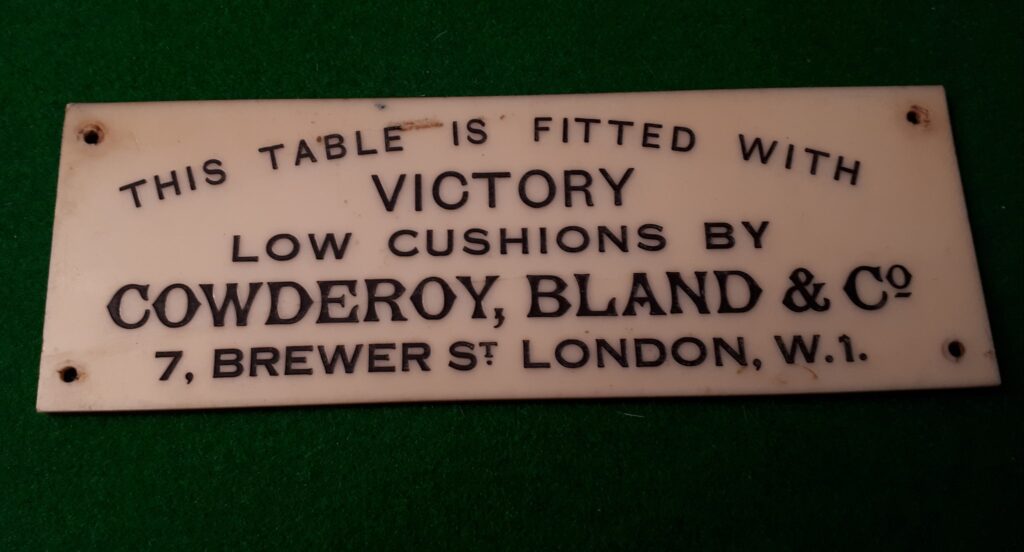
A notable innovation during this time was the introduction of the ‘Victory Low Cushion’. This cushion, first referenced around the time of their move to 19 Brewer Street, was possibly named to commemorate the British Army’s victory in the Sudan campaign, which had concluded the previous year. The typeface for the company name on these plates was later simplified to a sans-serif font as fashions continued to change.

The period between 1907 and 1914 marked the peak of Cowderoy, Bland & Co’s activities. In 1907, they expanded their services to include ball turning and began advertising with an extended address of 18-19 Brewer Street. Surviving artefacts from the company are statistically most likely to date from this peak period. Frederick John Cowderoy, Arthur’s son, was living in Wandsworth in 1907 when he filed a patent for “improved chalk holders”. If you happen to possess a cue marked “19 Brewer Street,” it likely dates from just before the First World War.
Wartime Transition (1917-1939)
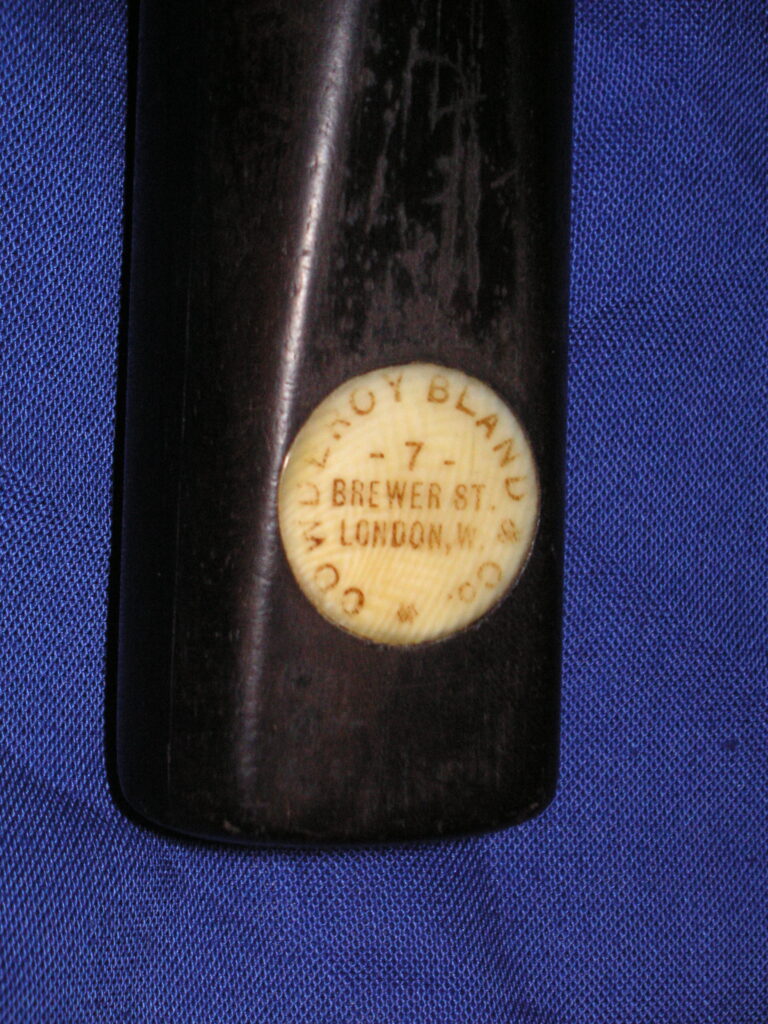
The First World War brought significant changes to many companies, and Cowderoy, Bland & Co was no exception. In 1917, the shop moved again, this time to smaller premises at 7 Brewer Street9. They were still located at this address in 1922. Although the scale of their operations was significantly reduced by the war, they continued to supply the ‘Victory’ cushion.
George Bland, one of the co-founders, passed away in 1923. Following his death, the manufacturing side of the business began to diminish, with a greater focus placed on table repairs and re-cushioning work. Arthur Cowderoy continued to manage the business alone. His son, Frederick, who had joined the company before the war, left to find other employment, possibly due to the downturn in business.
There seems to be differing accounts regarding the firm’s exact closing date. One perspective suggests that “Cowderoy & Co” ceased trading shortly after 1922, with the war being a contributing factor. Frederick John Cowderoy (likely Arthur’s son), described as a “retired Company Director,” may have died in 1936 at the age of 74, a date that would align with the company ceasing operations shortly after 1922. However, another source indicates that the “Cowderoy, Bland & Co” shop at 7 Brewer Street was still trading in 1939, albeit primarily involved in retail rather than manufacturing, under the control of the then 79-year-old Arthur. There is no trace of the business operating after this date. Arthur Henry Cowderoy himself lived until 1949.
A Glimpse at Their Craft
Cowderoy, Bland & Co produced a variety of billiard-related items, including billiard tables, undersize tables, and billiard/dining tables. They were known for their distinct ivory table plates and their expansion into producing billiard balls. Their ‘Victory Low Cushion’ was a notable product, and they also manufactured cues, with some bearing the “19 Brewer Street” address and some bearing the “7 Brewer Street” address.
Not long ago a fine example of their craftsmanship, a billiards scoreboard featuring revolving number panels and stained ivory ‘buttons,’ was offered for auction, though it remained unsold.
The history of Cowderoy, Bland & Co reflects a journey of entrepreneurial enterprise, adaptability, and the profound changes brought about by the turn of the century and the Great War. Their surviving pieces continue to tell the story of a significant London billiard maker and retailer.
John A Smith
Cues n Views
Acknowledgements:
Peter Ainsworth: “British Billiard Table Makers”


